 4.8 OUT OF 5
 Jesse Enkelaar
You can order custom grip socks directly from a factory in China, and some studios do. But it usually only makes financial sense above roughly 1,000 pairs per design. Below that, once you add sampling, quality control, freight, import duty and VAT, a specialist supplier is almost always cheaper per pair and far less risky for a single studio.
Studio owners often see a low per-pair price on a sourcing platform and assume a specialist is simply adding margin on top. Sometimes that is true. More often, the platform price hides a chain of costs and risks that only become visible once you actually place an order.
This article is the overview for Pilates, yoga, barre and fitness studios weighing that decision. It explains what direct sourcing involves, where the costs and risks sit, and how to decide. Each topic has its own in-depth article, linked along the way, so you can go deeper where it matters for your situation.
What ordering direct from a factory actually involves
Buying direct means you become the importer. You are not just paying for socks. You are managing the whole process that a specialist would otherwise handle for you:
- Finding the right factory. Not every sock factory can apply silicone or rubber grip, so the search is narrower than it looks.
- Preparing print-ready artwork. The factory expects finished files, not a rough logo and a brief.
- Sampling. You request and pay for samples, review them, and approve a physical proof before production starts.
- Paying. Terms are typically 30 percent up front and 70 percent before shipping, often by bank transfer with limited buyer protection.
- Shipping and customs. You arrange international freight, clear customs, and pay import duty and VAT.
- Inspection. You check the goods on arrival and deal with anything that is wrong.
None of this is impossible. It is simply a project, and the listing price is only the first line of the real cost. Where you find the factory matters too: our comparison of Alibaba versus a specialist supplier for grip socks looks at what you get, and what you give up, on each route.
Minimum orders are usually the deciding factor
For most studios, the minimum order rules out direct sourcing before any other cost is considered. A factory producing custom grip socks with your own logo on the sole typically sets a minimum of 500 to 1,000 pairs per design and colorway, because the setup only pays off at volume. Want two colors? You often need to meet the minimum twice.
A single boutique studio rarely sells that many pairs of one design in a year. Specialist suppliers can go much lower because they combine demand from many studios. Our article on the real minimum order for custom grip socks explains how factory minimums are counted and how to work out the quantity you actually need.
The real cost is more than the listing price
The listing price is the factory price for the socks and nothing else. On top of it, expect:
- Sampling fees, plus shipping for each round of proofs.
- A one-time setup charge for custom logo grip.
- International freight.
- Import duty, which for knitted socks entering the EU is generally around 12 percent.
- Import VAT, charged on the full customs value including freight and duty: 21 percent in the Netherlands, 19 percent in Germany and 20 percent in France.
- A customs broker fee and currency conversion costs.
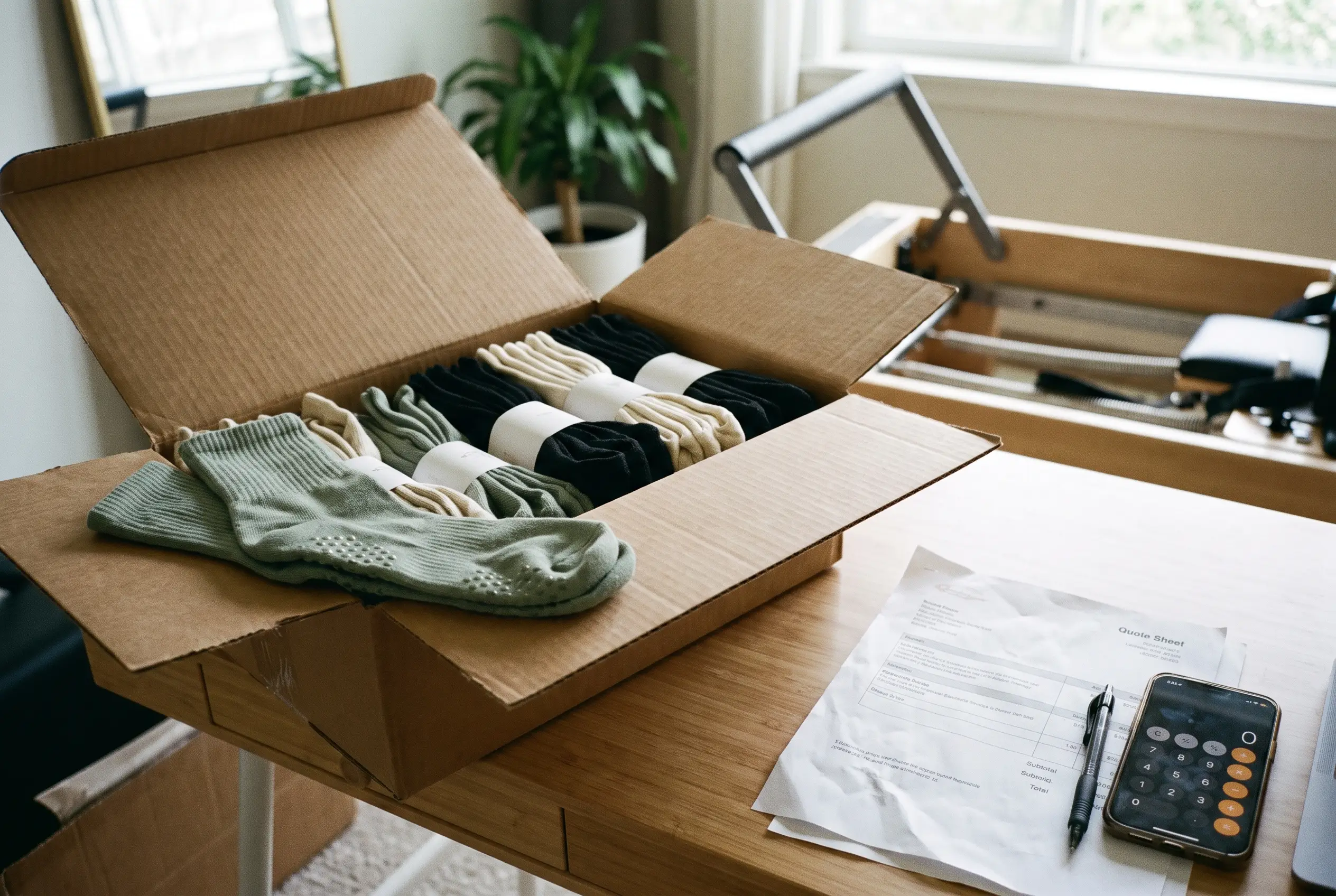
A sock that looked like it cost under two euros can land closer to four or five euros once everything is counted, and that is before you price in your own time. For a full worked breakdown, read what it really costs to import custom socks from China. For the paperwork side, including who pays what at the border, see our guide to customs and VAT when importing socks into the EU.
Quality and timing risks you carry yourself
Some risks never appear on an invoice. When you order direct, quality control is your responsibility. If the grip is applied unevenly, the sizing runs off, the color is a shade out or the logo reproduces poorly, you own the problem. Recourse across borders is slow and often unsuccessful, and unsellable stock sits in your storeroom as dead inventory you have already paid for. Our article on quality problems with grip socks ordered direct covers each failure and how to test for it.
Timing is the other risk. From first contact to delivered stock, a direct order commonly takes six to twelve weeks, and a failed batch means starting a large part of that over again. The lead time for custom grip socks from China article walks through each stage and how to plan around it. Payment, communication and recourse risks are gathered in our overview of the risks of ordering grip socks direct from China.
When direct sourcing makes sense
Direct sourcing is a volume game with real overhead. It tends to make sense when one or more of these apply:
- You order more than roughly 1,000 pairs of a single design. At that volume, the factory minimum is no longer a problem and fixed costs spread thinly.
- You have design and quality control capacity in house. Someone on your team can prepare files, judge samples and manage inspections.
- You run a multi-location group with warehousing and cash flow. Holding a large stock of one design is easier when it is spread across several studios.
For almost everyone else, and especially for a single studio placing a first order or wanting several small colorways, a specialist works out cheaper in real terms once time, risk and landed cost are included. Our article on when ordering grip socks direct from China makes sense looks at these scenarios in more detail.
Direct factory versus specialist supplier, side by side
| Factor | Direct from a factory | Specialist supplier (PilatesGoods) |
|---|---|---|
| Minimum per design | Often 500 to 1,000 or more pairs | From 50 pairs with a standard grip, from 100 pairs per color with a custom logo grip |
| Design | You supply print-ready files | Design files prepared for you, free mockup within 24 hours on business days |
| Sampling | Paid, often several rounds, managed by you | Handled for you |
| Import duty | Your responsibility | Paid by the supplier, no surprise customs bill |
| Quality control | Yours | The supplier's |
| Bad-batch risk | You carry it | The supplier carries it |
| Typical lead time | 6 to 12 weeks door to door | Within a few weeks, rush production possible |
| Best suited to | 1,000 or more pairs per design | Single studios, first orders, small runs and several colors |
How to decide for your studio
The right question is not which option has the lowest listing price, but which has the lowest true cost per pair for the quantity you actually need. Work through these steps before you commit:
- Estimate your realistic annual quantity per design and per color, based on members and sales, not on price breaks.
- Check that quantity against factory minimums. If you are in the low hundreds, direct sourcing is unlikely to fit.
- Build a landed cost per pair for the direct option, including sampling, setup, freight, duty, VAT and fees.
- Add a realistic value for your own time and for the risk of a failed batch.
- Check the timeline against your launch or campaign date, with a buffer.
Once you have your landed-cost estimate, compare it with a specialist quote for the same quantity. You can request the PilatesGoods pricelist to see per-pair pricing by quantity and make that comparison side by side.