 5.0 out of 5
 Jesse Enkelaar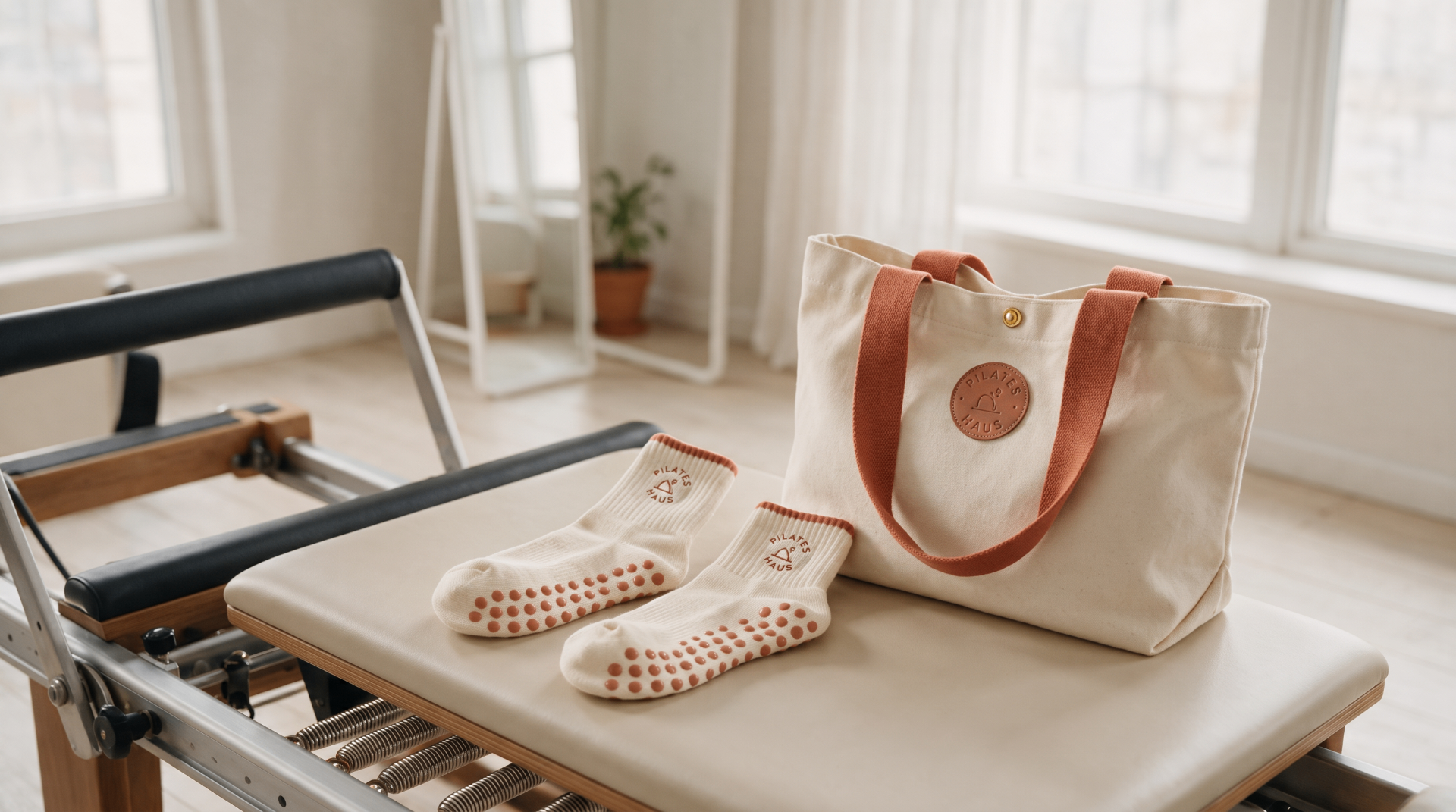
If you run a pilates or yoga studio, you've probably wondered: is merchandise even worth it? Gripsocks, bags, towels, caps, it feels like an extra cost on top of everything else you already manage. Inventory, design, storage, sell-through.
At PilatesGoods we work daily with more than 800 studios across six markets: the Netherlands and Belgium, the UK and Ireland, Germany, Austria and Switzerland, France, Scandinavia, and the US. What we see again and again is this: merch isn't expensive, it's one of the few investments that pays for itself within weeks, and after that it's close to pure profit.
In this article I'll share what we actually see in the numbers, what goes wrong for studios that get it wrong, and how to set it up properly yourself.
The math most studio owners haven't done yet
Take a studio with ten reformers running three classes a day. That's thirty members a day, times six days a week. That's 180 members walking through your studio every week.
Out of that group, a meaningful share don't own gripsocks, want a bag for on the go, or come back after a few months for a towel because it got hot during class. Studios that get this right for the first time often see their investment paid back within a month to six weeks, plus profit on top.
And that's profit without extra staffing costs. You pay the cost of goods, the rest is margin that doesn't eat into your class hours or your team's time.
What sells the most, and why
Based on what we see across our client base, the ranking is fairly consistent:
Gripsocks are the most repeat-purchased product by far. That's not a coincidence. Socks are a consumable: people need multiple pairs, they wear out, and in a reformer studio they're often close to a necessity for hygiene reasons. Bare feet on reformers means more cleaning and a less pleasant class experience for everyone. New members almost always buy socks first.
Bags are also a strong entry purchase for new members. They're practical, visible, and instantly work as walking advertising for your studio.
Towels are frequently bought by new members too, and are a natural upsell the moment the room heats up and people start sweating.
Caps are more of a seasonal product, mostly in summer and mostly with female members. A smaller seller overall, but a nice addition to the range.
One tactic that works particularly well: releasing socks in seasonal drops, a new colorway every quarter. People want to belong and want to collect the whole set. It functions almost like an informal loyalty program, without ever calling it that.
The biggest mistake: underpricing
The most common mistake we see is studios pricing their merch too low. Leads sometimes tell us our products are "too expensive" compared to the cheapest options on the market. But premium quality costs money and labor, and if you want to build a premium studio experience, cheap merch doesn't fit that picture.
Better to charge twenty euros for a genuinely good pair of socks than fifteen for three mediocre pairs. The real question is: which one do you wear with pleasure and pride, and which one still looks good after a few washes?
There's a psychological effect behind this too. If your quality is good, you can confidently charge more without it hurting your reputation. Sell low quality, and that same confidence works against you instead.
Unity: why your teachers need to wear the merch
One of the simplest and most effective sales strategies we see has nothing to do with tactics and everything to do with behavior. The teacher leading the class needs to be wearing the socks, the bag, or the cap themselves.
Members look up to their teacher. When the teacher wears it with pride, the purchase becomes almost automatic, the same way people pay for the class itself without thinking twice. The same goes for you as the studio owner: when you wear it, you create unity across your team and your community, and that unity makes selling easier.
Make buying frictionless
Beyond the teacher acting as a walking display, it helps enormously if the purchase itself takes zero extra effort. Platforms like B-Sport and other pilates and yoga studio CRMs now include a built-in webshop function. The moment a member books a class, they can add socks, a cap, or a bag in the same checkout. No separate shopping moment, no extra friction.
Case study: from poor-quality China sourcing to €1,500 in extra profit per month
One of our very first clients, a studio in Amsterdam, came to us with a familiar story. They used to source directly from China, and got mediocre quality time after time. Merchandise nobody wore with pride, which meant it didn't sell either.
After switching, the difference was immediate. Their members liked the products enough to feature them in their own Instagram and photoshoot content. Over the past year, they've reordered from us roughly ten to twelve times. When we run the numbers on the margin they make on what they buy from us, it comes out to around €1,500 in extra clean profit per month.
The difference isn't some hidden marketing trick. It comes down to a simple rule: a good product keeps selling, a bad one eventually stops.
Why some accessories aren't a luxury, they're a necessity
Gripsocks aren't just a sales opportunity, in many reformer studios they're close to a requirement for grip, safety, and hygiene. Bare feet on the equipment isn't just less pleasant for other members, it's a practical and hygienic risk most studios would rather avoid.
Community building also plays a role that's easy to underestimate. Uniform merch across members and teachers creates a sense of belonging, which in turn feeds retention.
What should you charge as a studio?
A rule of thumb that works well: price at a minimum of two times your purchase cost. If you buy socks starting from fifty pairs, for example, your cost per pair lands around ten euros. Sell those for twenty euros and you're in good shape. Buy larger volumes at a lower cost, keep that same retail price, and your margin simply grows.
For products like bags and caps, margin can often run a bit higher, up to around sixty percent on top of the purchase cost, especially as your order volume increases.
Why quality and sourcing genuinely matter
Sustainability isn't a nice-to-have anymore, it's become a dealbreaker for many members and studios. That goes beyond material choice. It's about whether you can be confident there's no child labor, exploitation, or carcinogenic dyes anywhere in the production process, something you can't simply take for granted with cheap sourcing out of countries like China.
Studios and their members are increasingly paying attention to this, and rightly so. It also ties into the bigger picture: if you want your merch to feel premium, the entire supply chain behind it needs to back that up.
The takeaway
For a lot of studio and gym owners, merch feels like an investment with an uncertain payoff. In practice, it's close to the opposite. Choose good quality, strong branding, and a reliable partner, and you'll typically earn the investment back within a matter of weeks, with structural, near staff-free profit after that.
We see this play out with nearly every studio we work with: once they experience how profitable it actually is, they come back. Not once, but again and again.