 4.8 OUT OF 5
 Jesse Enkelaar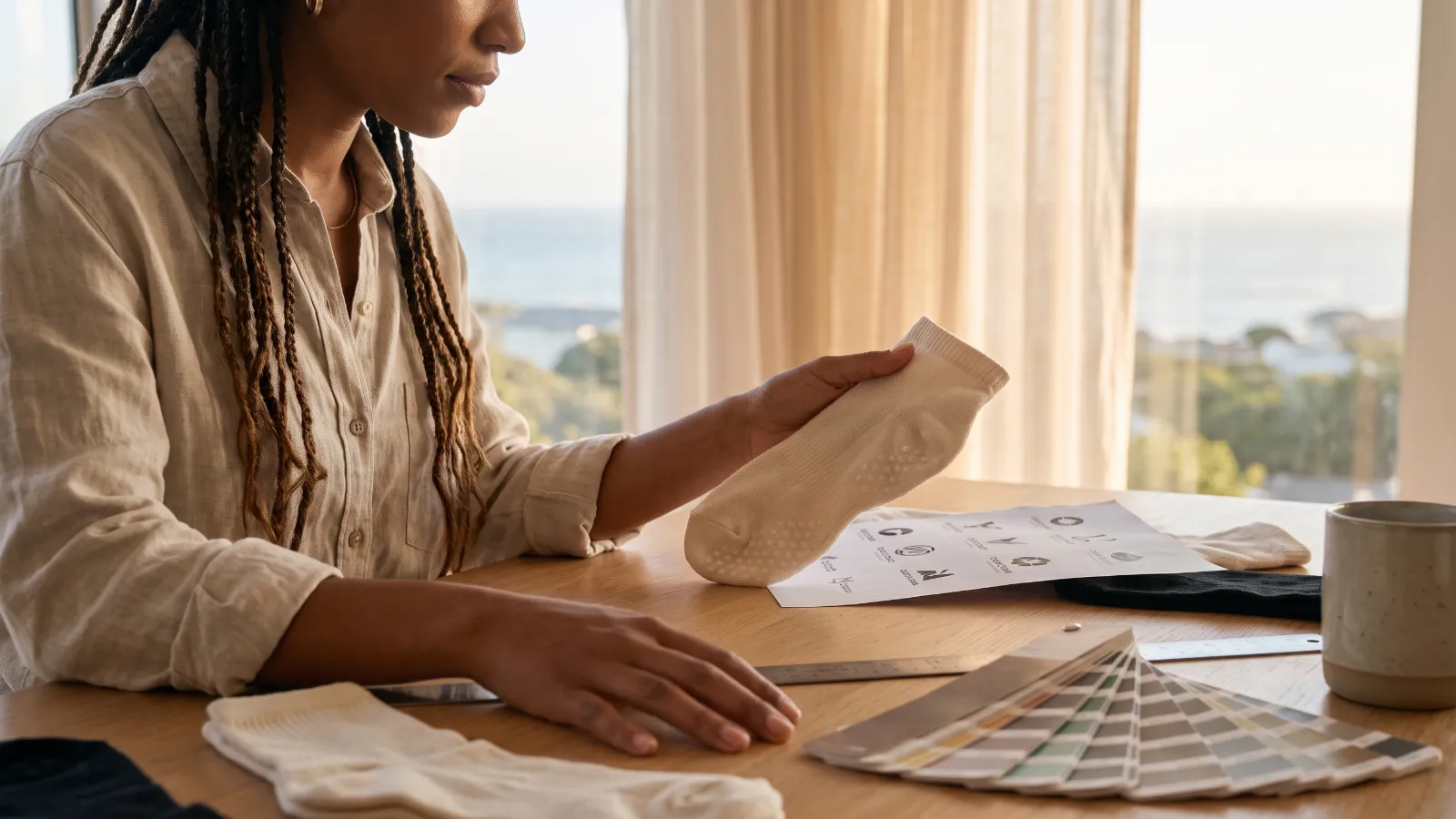
Yes, you can get your studio logo on the grip when you order direct from a factory, but only if your artwork is ready for it. The factory expects print-ready vector files, limits the number of colours, and needs the logo above a minimum size so the sole still grips. The grip itself is applied as silicone or rubber. Poor files and a rushed proof approval are the most common reasons a first direct order disappoints.
Putting a logo on the sole is more technical than most owners expect. It is not a print on fabric that only has to look good; it is the part of the sock that keeps a member steady on the reformer or the mat. That is also where the gap between a factory and a specialist shows most clearly.
This guide is for studio owners and designers preparing custom logo grip socks, whether you order direct or through a supplier. It covers the files to send, the colour and size limits, how the grip is applied, and how to approve a proof without regrets.
What files a factory needs for a logo grip
Factories work from print-ready vector artwork, typically AI, EPS or a high-quality PDF. A screenshot or a low-resolution JPG pulled from your website will not do. Vector files scale cleanly and define exact shapes and colours, which is what the grip application needs. If you supply a raster image or an unclear file, the factory will either reject it or reproduce it poorly, and you may not see the result until the physical proof arrives.
A complete artwork package usually includes:
- The logo as a vector file. Any text should be converted to outlines so fonts cannot be substituted on the factory's computer.
- A one-colour version. Even if your main logo uses several colours, the grip version is often simpler, so having an approved single-colour mark saves a round of back and forth.
- Colour references. Give exact colour codes rather than "our pink", so the grip colour can be matched rather than guessed.
- A note on intended size and placement. Say where on the sole the logo should sit and roughly how large it should be.
If your studio already has a brand style guide, most of this should be in it. If not, this is a good moment to put the approved logo versions and colour codes in one place.
How many colours a grip logo can have
Grip application usually limits colours, often to a small number, because each extra colour adds cost and complexity to the silicone or rubber process. A detailed, multi-colour logo may need simplifying into a cleaner, grip-friendly version. Knowing this in advance saves a round of samples. Discovering it after you have paid for a proof does not.
Gradients, drop shadows and fine outlines do not translate to grip at all, so they need to be flattened or removed. Many studios solve this by keeping the grip simple, often in a single colour, and carrying the full brand colours in the knitted body of the sock instead, where jacquard knitting or embroidery can show more of the design.
How the grip is applied, and why quality varies
Grip is applied to the sole as silicone or rubber, in dots, shapes or your logo itself. The quality of that application is what separates a sock that grips reliably for years from one that peels after a handful of washes. It depends on the material, the thickness of the layer and the care the factory takes in applying it.
The difficult part is that a cheap application looks fine on day one. It fails in the wash, which you only learn once your members are wearing the socks and the batch is already paid for. If you are ordering direct, ask specifically about the grip material and wash testing, and read our guide to quality problems with grip socks from a direct factory before you approve production.
Logo size and placement on the sole
There is a minimum practical size for a logo on the grip. Too small and the detail is lost; letters fill in and the mark becomes a blob. Too sprawling and the grip stops working as grip, because the pattern no longer spreads traction evenly across the sole. The right size sits between those two limits.
Placement matters as much as size. On a sole, the logo has to sit where it grips and reads well, not just where it looks good on a flat drawing. The general principles in our logo placement guidelines apply here too: judge the mark on the real usable area of the product, at real size. The difference is that a factory will produce what you send. It will not always tell you that it will not work.
| Logo element | On a grip sole | What to do |
|---|---|---|
| Bold icon or short wordmark | Usually reproduces well | Use it as the main grip mark |
| Thin lines and small text | Detail gets lost | Thicken strokes or drop the small text |
| Gradients and shadows | Cannot be reproduced | Flatten to solid shapes |
| Many colours | Adds cost and complexity | Reduce to a small, grip-friendly palette |
| Very large logo | Grip stops working as grip | Scale down or combine with a dot pattern |
Why first direct orders so often disappoint here
The pattern is familiar. The studio supplied imperfect files, approved a proof too quickly, or did not know the colour and size constraints, and the factory simply built what it received. Nobody in the chain was responsible for making the artwork production-ready, because that is a service, not a given. The result is a logo that looks off, grip that fails, or colours that missed.
A careful proof review prevents most of this:
- Check the proof at actual size. Print it at 100 per cent or hold a sample sock next to it.
- Compare colours against your references in daylight, not only on screen.
- Look at grip coverage. Make sure the logo leaves enough traction across the sole.
- Ask for a physical sample or a photo of one before mass production, not only flat artwork.
How a specialist handles the logo grip differently
A specialist usually includes a design service. They take your logo, prepare it for grip production, advise on colours, size and placement, and show you an accurate proof before anything is made. That single step removes the most common cause of a disappointing first order. You are paying not just for socks but for someone to make sure your brand actually reproduces well on the sole.
At PilatesGoods, a custom logo grip is possible from 100 pairs per colour. For smaller runs of 50 to 99 pairs, the sole uses a standard grip pattern and your logo goes into the knitted sock itself. You can see the options for custom socks with logo, and our guide on how to design socks with your logo covers the rest of the sock, from colourways to sock height.
Logo readiness checklist
Before you send artwork to any factory or supplier, check it against this list:
| Requirement | What the factory expects |
|---|---|
| File type | Vector (AI, EPS or high-quality PDF) |
| Colours | A limited, grip-friendly palette with exact colour codes |
| Logo size | Above the practical minimum for grip |
| Placement | Where it grips and reads well on the sole |
| Proof | Approved before production, not after |
Your logo can absolutely go on the grip, but only clean vector files, a sensible colour count and size, and a proper proof make it look right. If you order direct, all of that is on you. If you would rather see how your logo works on the sole before committing to anything, get a free design mockup within 48 hours on business days, with no obligation.