 4.8 OUT OF 5
 Jesse Enkelaar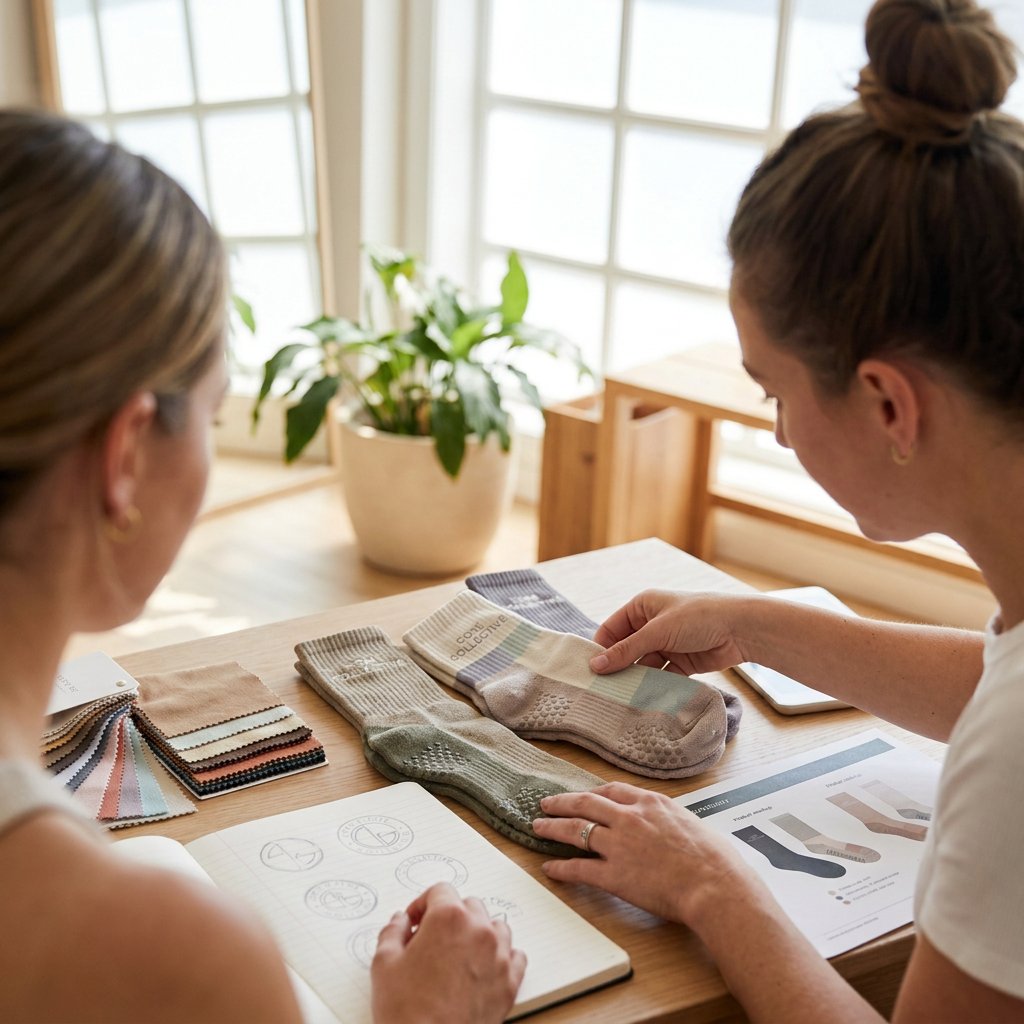
How to Design Your Own Socks With Your Logo for Your Studio
A good studio logo sock does not start with the logo alone. It starts with the balance between branding, wearability, and the practical limits of how socks are made. In most cases, cleaner artwork, fewer colours, and a sock style with enough visible space will give you a better result than a busy design with too many details.
Before you choose placement, colours, or quantity, decide what the socks are meant to do. Socks for class use, front-desk retail, staff gifts, member welcome packs, or event swag all need different choices around grip, style, lead time, and pricing. When that purpose is clear early, the design process gets much easier.
Start with what the socks need to do in your studio
The smartest way to design socks with logo for studios is to define the job first. A front-desk retail item needs to look giftable and easy to wear outside class. A class-use grip sock needs to feel comfortable, fit well, and still show your brand clearly. Teacher gifts, staff uniform socks, and event pairs can each push the design in a different direction.
That is why function should sit next to branding from day one. If the sock feels awkward, overly promotional, or hard to wear again, members are less likely to buy it or reach for it often. For Pilates, yoga, and barre studios especially, grip, fit, and a clear studio logo on grip socks need to work together. Decide whether your main goal is resale, member experience, or brand awareness before you choose artwork, grip layout, or sock length.
Pick a sock style that gives your logo enough room
Sock length changes both how your branding looks and how often members will wear the pair. The best option is usually the one that fits real studio habits, not just the one that gives you the biggest logo area.
| Style | Branding space | Best fit in a studio setting | What to watch for |
|---|---|---|---|
| No-show | Very limited visible upper area. Best for a small logo, subtle cuff detail, or branding focused more on the sole. | Works well for class-use grip socks where function comes first and members mainly wear them on the mat or reformer. | Clean and minimal, but easy to underbrand if you want a stronger retail item or a sock that advertises your studio at a glance. |
| Quarter | More room than no-show, with enough height for a simple logo or wordmark without crowding the design. | A practical middle ground for Pilates, yoga, and barre studios that want something easy to wear in class and beyond. | Still not a huge canvas, so detailed artwork or long text can start to feel cramped. |
| Crew | The clearest everyday branding area for most studios. Good for logos, icons, or a simple repeat pattern. | Usually the strongest choice for studio merch because members can wear it in class, with sneakers, or as a casual add-on purchase. | Needs balanced placement so the logo stays visible without making the sock feel too promotional. |
| Knee-high | Large surface area and a stronger visual statement, with more room for bold branding or extended graphics. | Best for a specific event, campaign, uniform look, or studio aesthetic where members are likely to embrace the height. | More niche than shorter lengths, so it tends to suit a targeted offer better than a broad everyday retail item. |
For many studios, quarter and crew styles are the easiest place to start because they balance logo visibility with repeat wear. If your audience prefers a minimal look, lower-cut styles can still work well with simplified artwork.
Make your artwork sock-friendly from the start
Socks are a small design surface, so the strongest artwork is usually the simplest.
- Simplify the logo before production. Tiny text, thin outlines, complex gradients, and crowded layouts rarely stay sharp once translated onto a sock.
- Use strong contrast and keep the colour palette tight. A logo should read quickly from a short distance, not depend on fine detail to make sense.
- Ask how the design will be built into the sock. Knitted-in branding, smoother panels, or printed sections can handle detail and finish differently, so the method affects the result.
- If you are designing grip socks, treat the upper and the sole as two separate surfaces. The top carries the brand look, while the grip layout has its own functional role.
Use a design workflow your team can actually follow
If you are wondering how to design your own socks, keep the process simple and work in order.
- Start with the basics: your logo files, brand colours, preferred sock style, target quantity, and a clear note on whether the socks are for retail, classes, gifting, or an event.
- Turn that into a short brief before discussing artwork details. A good brief prevents avoidable back-and-forth later around placement, scale, grip, and colour choices.
- Review a mockup carefully and make revisions before approval. This is where you check logo size, visibility, overall balance, and whether the design still feels like your studio.
- Build in sample review where possible, especially if the socks will be sold at the desk or used often in class. Fit and finish matter as much as the artwork.
- Use supplier design support if your files are not production-ready. At PilatesGoods, many projects start with a simple brief and a free custom mockup rather than finished art.
Check the order details that change the end result
Good custom socks are not only about the design. Small ordering details can change quality, timing, cost, and how sellable the final pair feels in your studio.
- Confirm the minimum order for custom grip socks early. Low minimums can make testing easier, while larger runs may reduce the per-pair cost. At PilatesGoods, standard custom sock programmes start at 50 pairs, which can be useful if you want to trial a design before committing to a bigger reorder.
- Ask for realistic custom grip sock lead times, not just the fastest-case estimate. If your socks are tied to an opening, retreat, holiday push, or member event, work backwards from the date you need stock in hand. PilatesGoods states an approximate production and delivery timeline of 4 to 8 weeks for custom socks, so planning ahead matters.
- Clarify shipping timing separately from production timing. A project may be finished in the factory but still miss your deadline if shipping is not aligned with your launch plan, especially for international delivery.
- Review mockup and sample options before you approve a full run. A mockup helps with artwork and placement, while a sample, where available, helps you judge fit, finish, and whether the product feels retail-ready.
- Check material and finish options against the real use case. Class socks, welcome gifts, and premium studio merchandise may need different priorities around feel, durability, or overall presentation.
- If you plan to resell the socks, talk about packaging early. A pair that arrives loose in bulk may still work for operations, but retail presentation often needs more thought if you want the product to look giftable at the front desk.
Work out the retail math before you order
Is selling socks profitable? It can be, but only if you price from the full landed cost and the role the product plays in your studio. There is no single right price for custom socks.
| Sock role | Main cost drivers | Pricing lens | What to check |
|---|---|---|---|
| Class-required grip socks | Grip layout, quantity, shipping, and whether you need repeat stock. | Price for convenience and steady sell-through, not just maximum margin. | Will members buy them easily at the desk when needed? |
| Premium branded merch | Style, materials, packaging, and more developed branding details. | Higher perceived value can support a stronger retail price. | Does the product feel like real merch, not a promo item? |
| Gift or event socks | Deadline pressure, packaging, and shorter-run economics. | Margin may matter less than experience, presentation, or brand impact. | Are you pricing for profit, retention, or occasion value? |
Know what to look for in a supplier before you send the brief
Where can you get custom grip socks with your logo? Start with a supplier that understands the product, the design limits, and how studios actually use socks.
- Look for clear communication first. A good supplier should explain what will translate well onto the sock, what may need simplifying, and how mockups or samples fit into the process.
- Be wary of generic merchandise sourcing that treats socks like just another promo product. Studios usually get better results from a partner that understands grip socks, fitness retail, and repeat class use.
- Compare suppliers on consistency, lead time transparency, shipping clarity, and how easy reordering will be. If a design sells well, you want a process you can repeat without starting from scratch.
- Once your basic brief is clear, PilatesGoods is a natural specialist option for studio-branded socks and merch. You can start your sock design with a free custom mockup or request the price list, then review the best fit for your design, quantity, and timeline.