 4.8 OUT OF 5
 Jesse Enkelaar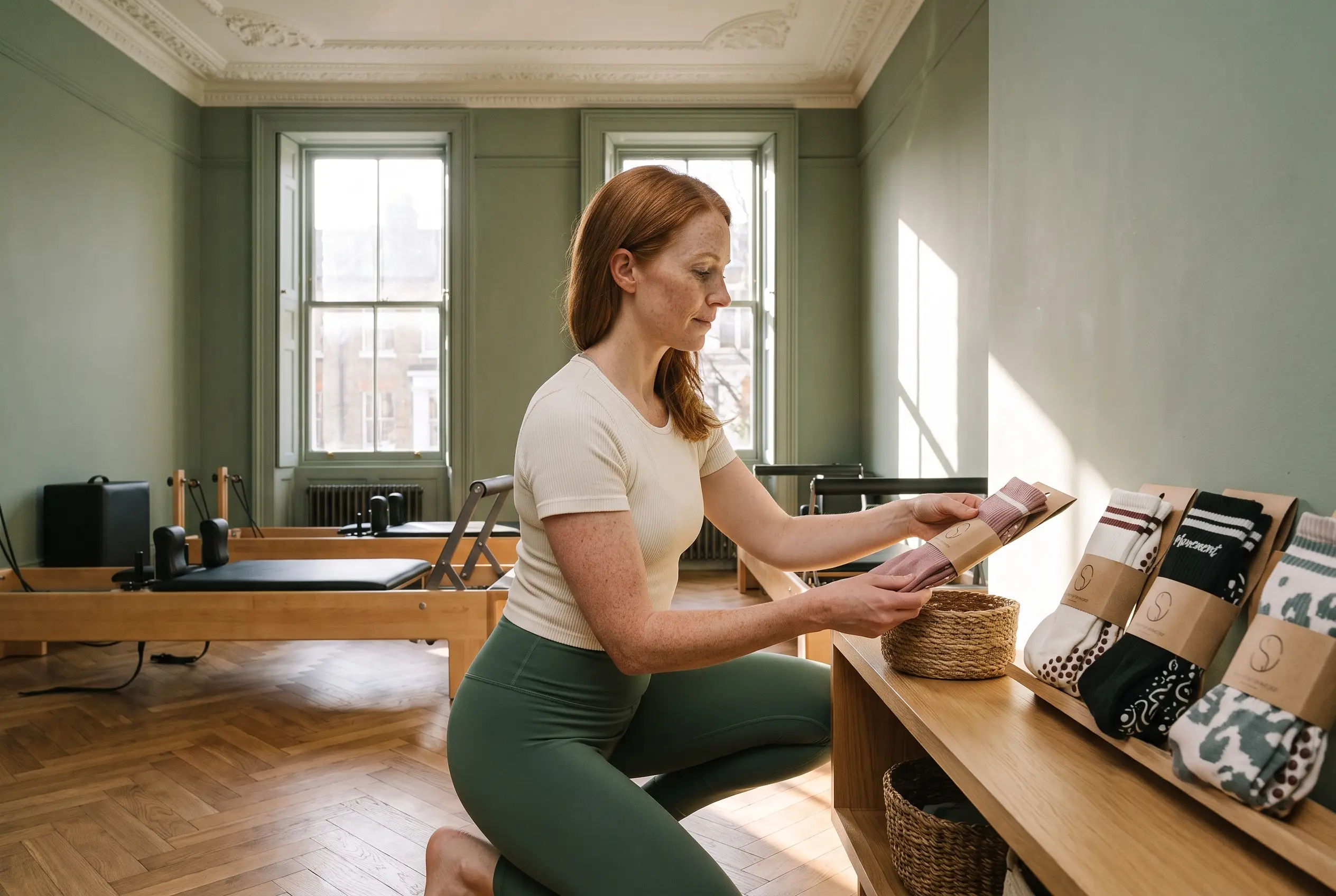
Good sock packaging has to do three jobs at once: make the product look retail-ready, keep each pair neat, and give shoppers the basics they need before they buy. In a studio setting, that matters more than people expect. Socks are often a small-ticket item, so presentation has to work fast at the front desk, on a shelf, in a basket, or inside a shipped order.
For most studios, the main choice comes down to sleeve-style packaging versus box-style packaging. Sleeves and bands are lighter and efficient. Boxes feel more premium and giftable. The right answer depends on your price point, how you display the socks, and whether they are sold as impulse add-ons, bundles, or part of a gift set. Below, you’ll find practical guidance on format, print content, materials, finishes, sizing, and approvals so your custom grip socks or merch socks look as considered as the rest of your brand.
What good packaging needs to do in a busy studio
Packaging is not just decoration. In a studio retail setup, it helps socks stay paired, stacked, and easy to browse. That alone makes day-to-day handling easier for staff, whether the pairs are sitting by reception, arranged on shelves, or packed into outgoing e-commerce orders. A loose sock product can look messy fast. A well-sized pack keeps the display clean with less effort.
It also shapes how the product feels in the customer’s hand. Custom grip socks with your studio logo can either read as a thoughtful studio product or as a generic add-on, and packaging plays a big part in that difference. Good packaging helps with display, light protection, product information, giftability, and quick handling at checkout.
The best choice depends on how you sell. If socks are an impulse buy near the desk, a simple wrap may be enough. If they are part of a curated retail line built around the yoga and pilates accessories that sell most, a bundle, or a gift-focused offer, a more structured format can make better sense.
Sleeve, band or box? Pick the format that fits how you sell
| Format | Best for | How it sells | Watch for |
|---|---|---|---|
| Slim sleeve or belly band | Folded single pairs in countertop baskets or stacked displays | Low footprint, tidy look, efficient for everyday retail | Limited protection and less space for detailed messaging |
| Full wrap | Shelf retail where front and back print both matter | More branding room and cleaner product photography online | Still a lighter format, so it is not the most gift-led option |
| Header-card style | Peg displays or hanging merch walls | Easy to browse, size-label and organise in tighter spaces | Needs a clean fold and balanced hole placement |
| Box | Premium merch, gifting, or cleaner shipped presentation | Higher shelf presence and better structure | More volume, more material, and a higher cost feel |
| Multi-pair pack | Bundles, starter packs, promos, and value sets | Keeps sets together and supports higher basket value | Needs very clear quantity and size information |
What to print so shoppers get the basics fast
The best sock packaging reads clearly in a quick glance. Shoppers should spot the brand first, understand the product second, and find the practical details without turning the pack into a wall of text.
- Brand name and logo: make recognition immediate from a shelf, basket, or front-desk display.
- Brand colours and artwork style: keep the pack visually tied to your studio, not to a generic retail template.
- Typography: use a font system that matches your brand and stays easy to read at small size.
- Short product descriptor: examples include grip socks, crew socks, studio socks, or gift set.
- Size information: one of the most useful details for both staff and shoppers.
- Fibre content and care notes: practical information that helps after purchase and reduces confusion at checkout.
- Barcode or SKU space: important if you track retail inventory or ring items through a POS system.
- Optional secondary messaging: thank-you copy, a QR code, simple care guidance, or a bounce-back offer only if it adds value without clutter.
Choose materials that feel right and hold up well
Material choice changes both the look of the product and the day-to-day practicality of selling it. For studio socks, the right material is rarely the thickest one. It is the one that fits the product, the sales channel, and the budget while still feeling intentional in hand.
| Material direction | Feel and print result | Best use | Trade-offs |
|---|---|---|---|
| Standard paperboard | Clean surface, sharp print, strong brand colour presentation | Most sleeve, wrap, and folding-carton applications for single pairs | Balanced option for cost and appearance, though lighter structures offer only modest protection |
| Kraft-style paperboard | More natural, pared-back look with a softer visual feel | Studios that want a minimal or more understated brand expression | Printed colours can look less bright than on coated white stock |
| Heavier folding carton board | More structure and a more substantial hand feel | Premium single-pair packs, boxed sets, or cleaner shelf presentation | Higher material use and more storage volume than lighter wraps |
| Corrugated board | Protective and practical rather than refined | Bundles, subscription-style packs, or shipping-led outer packaging | Less polished for direct shelf display unless branding is handled carefully |
| Rigid box formats | Most premium feel, structured opening, gift-ready presentation | Higher-ticket gift sets, launches, or special retail moments | Highest cost position, most storage space, and often more packaging than everyday sock retail needs |
If sustainability is part of the decision, simpler paper-based formats are often the most practical route. Lighter packs generally use less material, and paper options with fewer coatings are usually easier to recycle than heavily finished constructions. That does not mean every studio needs the lightest possible pack. It means the material should earn its place by improving display, protection, or gifting rather than adding weight for the sake of it.
Use print methods and finishes where they add real value
Print method and finish can make a small product look much more polished, but they should support the retail goal rather than complicate it. If you are producing a short run, testing a new design, or working with several small variations, flexibility matters. If you are rolling out a larger merch programme and need tighter brand consistency, the print approach may need to be more controlled from the start.
| Print approach | Best fit | Main advantage | What to watch |
|---|---|---|---|
| Digital printing | Shorter runs, artwork tests, multiple small design versions, or quicker packaging development | Flexible and efficient when you do not want to commit to a larger print setup too early | Colour can still look great, but brand matching should be checked carefully if your studio palette is very specific |
| Offset or tightly controlled brand-colour printing | Larger runs or programmes where consistency matters across reorders and product lines | Stronger control over repeated colour output and a polished retail finish at scale | Usually makes more sense once artwork is locked, because later changes can be less efficient |
Finishes work the same way. The best ones add clarity, durability, or premium feel without making a straightforward retail sock pack feel overdesigned. For many studio brands, a clean matte or light protective coating is enough. For higher-ticket gifting, limited tactile or reflective details can help. The key is restraint.
| Finish | What it adds | Good use case | Trade-offs |
|---|---|---|---|
| Matte | Soft, modern, understated look with reduced glare | Minimal studio branding and cleaner shelf presentation | Can show scuffs more easily than some harder coatings |
| Gloss | Brighter colour pop and more reflective surface | Bold graphics or packaging that needs to stand out from a distance | More glare in strong lighting and in product photos |
| Soft-touch | Velvety feel that reads more premium in hand | Gift-oriented packaging or elevated brand launches | Adds cost and can be more than everyday studio merch needs |
| Anti-scratch | Extra surface resilience for darker or more easily marked packs | Packaging handled often on shelves or through shipping | Worth using only if scuff resistance solves a real problem |
| Varnish | Light protection or selective visual emphasis | Simple enhancement without turning the whole pack into a premium effect piece | Needs planning so small text still stays crisp |
| Spot UV | High-contrast shine on selected elements such as a logo or pattern | Controlled premium detail on otherwise simple packaging | Can hurt readability if used on small text, and should stay away from barcode areas |
| Foil | Reflective metallic accent with strong visual impact | Gift sets, limited editions, or special launches | Adds cost, can increase lead time, and is easy to overuse on everyday merch |
| Embossing | Raised texture that makes logos or marks feel more tactile | Premium branding where touch is part of the experience | Works best with simple artwork, not dense information panels |
| Debossing | Pressed-in detail for a quieter, more subtle premium look | Minimal branding on giftable packaging | Can lose impact on thin materials or busy layouts |
Every added effect has a cost beyond the visual. Special finishes can change unit cost, extend approval, affect custom grip sock lead times, and create issues for small care text or barcode scanning if they are placed badly. A practical rule is this: if the finish improves shelf presence, brand feel, or durability in a clear way, keep it. If it only makes reorders more complex, it is probably not doing enough work.
Size it for single pairs, bundles and gift sets
Packaging dimensions should be based on the actual folded sock, not a rough guess, and should be planned alongside the minimum order for custom grip socks. Sock height, thickness, fold style, and pair count all change the final pack size.
| Pack type | What changes the size | Practical sizing note |
|---|---|---|
| Single pair, no-show or ankle style | Lower height and slimmer fold | Usually suits compact sleeves or cards with very little wasted space |
| Single pair, crew or taller style | More length and more fold depth | Needs enough panel height to avoid bunching or overhang |
| Thicker knit or grippier folded pair | Extra bulk through the middle of the pack | Allow enough depth so the pack looks snug, not squeezed |
| Multi-pair bundle or gift set | Pair count, stacking pattern, and any inserts | Confirm the final packed sample before artwork is approved |
Snug sizing makes packs stack better, look cleaner, and avoids loose or crushed presentation. Always confirm dimensions from the real folded sample before production moves forward.
How the process usually runs from idea to approved packaging
The smoothest packaging projects follow a simple sequence and keep fit checks early.
- Define the retail goal first: impulse buy, premium shelf item, bundle, or gift set.
- Choose the structure that fits that goal, such as a sleeve, wrap, card, or box.
- Select the material and finish based on brand look, handling needs, and budget.
- Add artwork and product details, including size, care notes, and barcode or SKU space.
- Review mockups or proofs and test the packaging on the actual folded sock sample.
- Approve production only after fit, text readability, and barcode placement are fully checked.
A revision round is normal, and lead time becomes much clearer once the structure, material, finish, and artwork are locked. What usually adds delay is late size changes, missing product information, moving barcode areas, or adding special finishes after approval. If you are already developing custom grip socks, start your design and plan the packaging alongside the sock project rather than treating it as a last-minute extra.