 5.0 out of 5
 Jesse Enkelaar
Product assortment in retail is the mix of categories, products, variants, and quantities a retailer chooses for a specific customer, store, or channel. In simple terms, it is the answer to three everyday retail questions: what should we sell, how much of it should we carry, and where should it be available? Get that mix right and you support sales, margin, sell-through, and customer satisfaction. Get it wrong and the pain shows up fast through stockouts, overstock, slow-moving items, and extra markdowns.
This guide breaks down the main assortment models retailers use, the factors behind smart product mix decisions, how assortment planning connects to allocation and replenishment, and the numbers worth watching if you want the range to perform better.
Why the right mix matters more than having more products
Assortment management in retail is not about stuffing the shelf or website with the highest possible number of items. The real job is to offer enough choice to win demand without tying up too much cash in inventory that moves slowly. Every extra product adds complexity: more buying decisions, more stock to track, more space pressure, and more chances to back the wrong item.
That trade-off is where most assortment problems begin. Best sellers go out of stock because demand was underestimated. Weak sellers pile up because the range was too broad or too deep. Markdowns rise because inventory landed in the wrong store, season, or price point. And when shoppers cannot find the product, size, style, or color they expected, they often switch to another retailer instead of waiting.
Because of that, product assortment decisions directly affect sales, gross margin, inventory turnover, and customer satisfaction across both physical stores and online ranges. A strong assortment does not just create choice. It creates relevant choice.
Breadth, depth, and localization: the building blocks of a smart assortment
Most assortment strategy decisions come down to three levers. Breadth is how many categories you carry. Depth is how many options you offer within each category. Localization is how much the range changes by store, region, or channel.
A smart store assortment rarely looks identical everywhere. It should reflect available space, shopper profile, climate, seasonality, and the role of the channel. A flagship store, a small-format store, and an online shop may all serve the same brand but need different ranges. Depth also goes beyond raw SKU count. It includes sizes, colors, styles, pack sizes, and price points inside a category. That is why a retailer can have a narrow range overall and still offer meaningful choice where customers care most.
The five assortment models retailers actually use
| Assortment model | Customer promise | Best fit | Main trade-off | Simple example |
|---|---|---|---|---|
| Wide assortment | Many categories in one place | Retailers trying to cover multiple shopper needs | Less depth per category and more complexity across the total range | A home store carrying kitchen, storage, bedding, and décor, with a limited number of options in each |
| Deep assortment | More choice within a focused category set | Specialty retail and expert-led formats | Higher inventory investment inside fewer categories | A running store offering many shoe fits, sizes, price points, and accessories |
| Scrambled assortment | Unexpected extras beyond the core category | Retailers looking to increase basket size or attract broader traffic | Can dilute positioning if the added categories feel random | An apparel store adding candles, drinkware, and beauty minis near checkout |
| Localized assortment | A range matched to local demand | Multi-store retailers with different customer profiles or climates | More planning, forecasting, and allocation work | A grocery chain changing snack, beverage, or seasonal lines by neighborhood |
| Mass-market assortment | Broad appeal for the largest possible audience | Large chains serving mainstream demand at scale | Harder to stand out and easier to carry too much average product | A national retailer stocking standardized basics across most locations |
How to choose the right mix for your store
Choosing a merchandise assortment strategy gets easier when each category has a job. Not every product needs to do the same work.
- Start with demand data. Look at unit sales, sell-through, search data, repeat purchases, returns, and stockout history to identify the yoga and Pilates accessories that sell most. Customer demand should shape the core range before personal preference or supplier pressure does.
- Define the role of each item. Some products are traffic builders that bring shoppers in. Others are profit drivers with healthier margins. Others support the basket by pairing naturally with a core purchase. A good assortment balances all three.
- Match the range to capacity. Shelf space, storage, cash flow, and online navigation all limit how much choice customers can usefully handle. If the store cannot present or replenish the range well, the assortment is too large.
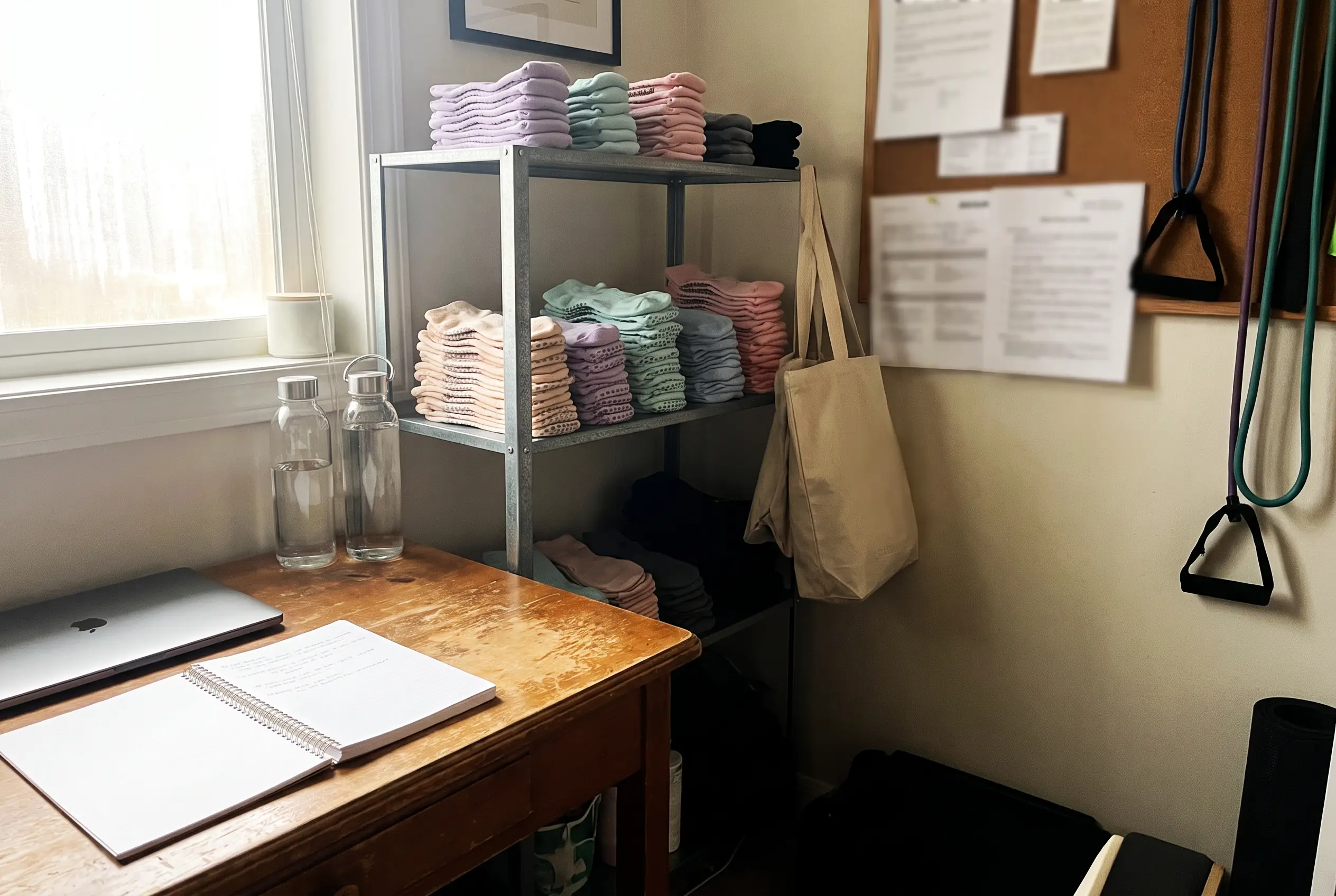
- Build around complementary products. The strongest assortments often combine a core need with a few well-matched add-ons. In boutique fitness retail, for example, branded grip socks can sit naturally beside towels, bottles, or bags instead of unrelated extras. That focused, studio-first logic is also why PilatesGoods centers its custom merch for Pilates studios on products that fit how studios actually sell.
- Protect the brand position. Specialty retailers often perform better with a focused core assortment and selective depth than with maximum breadth. If your brand stands for expertise, convenience, value, or style, the range should make that clear.
- Review by category, store, and channel. An assortment manager or merchandiser should revisit the mix regularly, because customer behavior shifts with seasonality, local demand, pricing, and new trends. What worked last quarter may not deserve the same space now.
How assortment planning works from target to replenishment
Assortment planning starts with targets. Retailers set sales, gross margin, inventory, and turnover goals, then translate those into category roles and range decisions. That means deciding which categories matter most, how broad the range should be, how much depth each category needs, which price points must be covered, and how many units to buy. From there, the retailer moves into initial quantities, store or channel allocation, and launch timing.
It helps to separate a few terms that often get blended together. Assortment planning is the strategic decision about what belongs in the range. Listing is the step that authorizes specific products for specific stores, sites, or channels. Allocation is the initial placement of stock. Replenishment is the ongoing process of topping up inventory as products sell. Together, these steps turn a planned assortment into actual on-shelf and online availability.
The important part is that the pre-season plan cannot be left alone. Live sales and stock signals are what show whether depth is too heavy, demand was missed, or stores received the wrong mix. If action comes too late, gross margin erodes through missed sales or markdowns. In retail systems such as SAP Retail, assortment and listing usually refer to assigning the right products to the right stores or channels, but the commercial result still depends on good forecasting, clean allocation, and timely replenishment.
The numbers that tell you if your assortment is working
- The sell-through rate shows how much of the range is actually moving. Low sell-through can point to too much depth, weak demand, or the wrong price point.
- Stock turnover shows how efficiently inventory converts into sales. Slow turn often signals excess assortment or poor replenishment settings.
- Ending inventory shows what is left behind. Too much leftover stock can reveal overbuying, weak localization, or weak product exits.
- A retail margin calculator guide can help show whether the mix is financially healthy, not just popular.
- Markdown rate shows where the assortment was too optimistic or arrived at the wrong time.
- Stockout frequency highlights missed demand, late replenishment, or insufficient depth in key lines.
- Review results by category, SKU, and store, not just total sales. Also separate assortment from merchandising: assortment decides what makes the range, while merchandising and display affect how products are presented and discovered.
Quick answers to related retail terms
A few retail terms get mixed together with assortment work. Here are short, practical definitions that keep the focus on product mix decisions.
What is stock assortment?
Stock assortment is the live set of SKUs currently stocked and offered for sale in a store, category, or channel. It is the operational version of the planned assortment, so it changes with replenishment, seasonality, availability, and local demand. A strong stock assortment keeps key items available when shoppers want them, without carrying so many slow movers that inventory becomes expensive and hard to manage.
What are the 7 types of retailers?
A common way to group retailers is into department stores, supermarkets, specialty retailers, convenience stores, discount stores, big-box retailers, and pure-play e-commerce retailers. These are business formats, not assortment strategies. Each format tends to favor a different product mix: specialty retail often leans into depth, while supermarkets and big-box chains rely more on breadth, scale, and location-specific adjustments.
What is product display in retail?
Product display in retail is the placement and presentation of merchandise in-store or online to improve visibility and conversion. It includes shelf position, fixtures, page layout, featured collections, and cross-sells. Display is not the same as assortment. A strong display can help complementary products and impulse items sell better, but it cannot fix the wrong category mix, weak depth, or poor availability.
What are the four types of product strategies?
That phrase depends on the framework being used, so it is not a fixed retail rule. From an assortment point of view, four practical strategy types are breadth, depth, localization, and differentiation or exclusivity. The right choice depends on what customers expect, how the channel is meant to perform, and whether the business needs traffic, margin, authority, or a more distinctive offer.